How we run implementation projects
We want to deliver value early, and focus initial efforts on the Core Implementation, which will give you access to our products sooner. Alongside that phase, we start preparing for the Added Services that are included in the scope of your project.
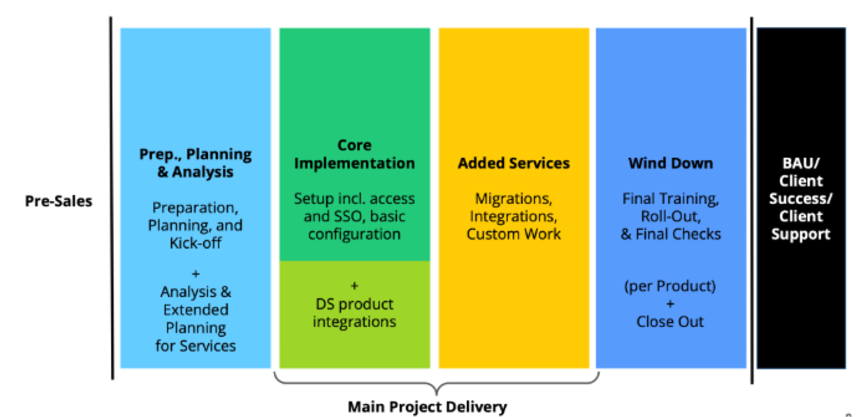
In order to have strong transitions between the project phases we identify a Primary Client Contact, who will lead you from Pre-Sales, through your implementation, and into Business-as-usual, once you go live.
Phase | Primary Client Contact |
|---|---|
Pre-Sales | Sales/Account Manager |
Preparation, Planning & Analysis | Head of Projects |
Core Implementation | Project Manager |
Added Services | Project Manager |
Wind Down | Head of Projects |
BAU | Client Success Manager |
Pre-Sales
In this phase we review the project contracts to get a first impression of the project scope, and the resources required. We start talking with your Account Manager to ascertain whether there is a need for a Pre-Sales Solution call, to discuss your requirements.
Preparation, Planning & Analysis
As soon as your project contracts have been countersigned, we move to the Preparation, Planning & Analysis phase, which starts the clock on the set of tasks that we need to complete before a project is kicked-off.
In this phase the ownership of the project passes to the Head of Projects, and we begin the preparation in earnest.
We identify the project team, we request provisioning of environments, we start communicating directly with you, and help you complete the Implementation Questionnaire/Survey, if required.
We also schedule in these calls, to ensure the transition from Pre-Sales is as smooth as possible:
Project event | Purpose | Lead |
|---|---|---|
Internal call | The purpose of the Internal call is to initiate the handover from Sales to Client Services. | Head of Projects |
(If required) Solutions calls | The purpose of Solutions calls is to ensure that business cases are aligned with product capabilities. | Solutions Specialist |
Planning call | The purpose of the Planning call is to align expectations about scope and timelines before the project officially starts. | Head of Projects |
Kick-off call | The purpose of the Kick-off call is to formally start the project. | Project Manager |
Note: all of these calls depend on the availability and readiness of both customer and Digital Science resources.
Kicking off the project
In advance of kicking off your project, we need the following in place:
A countersigned Statement of Work
A high-level Project plan
A Project brief
A Resource plan
Core implementation
Once a project kick-off has taken place, the ownership of the project passes from Head of Projects to the allocated Digital Science Project Manager.
The nature of the work, typical duration, and resources requirements, depend on what kind of Core implementation we are running. Core implementations include:
For new customer
Figshare installation
Symplectic Elements installation
For existing customers
Symplectic Elements - Discovery implementation
Symplectic Elements - Hosting migration
Symplectic Elements - Award Management implementation
At this point, we give you access to the Asana project that we have set up for you. This is where we meet to collaborate on the detailed tasks involved with the project.
Project event | Purpose | Lead |
|---|---|---|
Ongoing Project call | We provide Ongoing Project Calls to:
| Project Manager |
Status update | We provide regular Status updates in Asana | Project Manager |
(If required) Solutions calls | We provide Solutions calls, if these are required for specific deliverables | Project Manager |
(If required) Other calls | We provide other calls, if these are required for the project - these should be chargeable. | Project Manager |
Protecting the project (and your use case)
In order to protect the project and its corresponding business case, we need to formally manage the Project Scope and Project End Date.
To help with this, we will ask you to approve the agreed Project Scope or Project End Date, at the start of the project, and whenever these need to change.
Project safety
We want a collaborative spirit on our projects, and we want to treat each other and our customers with respect.
Escalation pathways
If you have concerns that you want to raise the profile of, please don't hesitate to reach out to us, using the following escalation path:
Project Manager
Head of Project (Kay Lino)
VP Client Services (Geirmund Knutsen)
SVP Client Solutions (Holly Wolcott)
Added Services
As the project progresses, we regularly update the overall timeline, and we only extend the project with task lists when the work needs to start.
Each added service is considered a project-within-a-project that needs to be resourced and scheduled (who does what, and when), alongside all other commitments.
Added Services include:
Figshare Legacy Migration
Symplectic Elements Data Feed/Migration
Symplectic Elements RT2 Repository integration
Wind Down
At some point the project will wind down, and the Project Manager will request Project Closure.
The project phase is set to ‘Closing’ and the ownership of the project passes from the allocated Project Manager back to the Head of Projects.
This is when any retrospectives take place, and Client Success re-engages with you to assist with the transition to Business as Usual.
When all relevant tasks have been completed the project status and project phase are set to ‘Complete'.
BAU
If you are running a multi-phased project, with more than one go-live, we will ask you to engage with our helpdesk for any request that concerns the live system.
--
How we run implementation projects presentation (PDF)