
Overview: Roll-out
In this article we will dive into the considerations that we would recommend at the very end of an implementation project, outlined in How we run implementation projects.
Overview
Having undertaken numerous implementations for a list of large academic institutions we have observed some qualities that make an implementation successful. At the end of an implementation project the Roll-out phase occurs once your installation of Elements has been installed, fully configured and integrated with existing systems (e.g. repository, HR) at your institution. Planning for and orchestrating a successful, well-advertised and positive Roll-out can be key to ensuring adoption of Elements by your academic and administrative users.
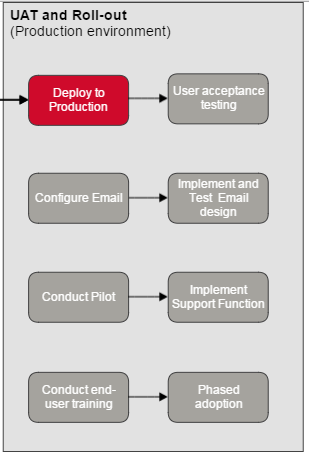
This diagram is part of the full implementation diagram
Driver | Client |
|---|---|
Symplectic Primary Contact | Client Support Manager |
Start of Activity | As early as possible |
End of Activity | Go-Live |
Expected Length | 2-6 weeks, depending on scope and end user training schedules |
Roll-out
We recommend that the Roll-out activity – the initial institutional deployment of Elements – is planned early. Even though the Roll-out is at the end of your implementation project, some of the work may need to be done up front.
Planning
We advise an approach where the team of stakeholders in charge of implementing Elements prepares for Roll-out far in advance. A crucial step in ensuring success is to get buy-in from key stakeholders so that Elements is promoted across faculties, departments and administrative duties.
When building an initial approach the following questions could be useful for structuring your efforts and inquiries:
What is the story?
How do I communicate what Elements is?
Why has it been implemented at our institution?
What sort of day to day problems is it going to solve for my colleagues and how will it make our lives easier?Who will be involved?
What impact will the use of Elements have on staff and technology in terms of resourcing ?
Is it likely to need frequent input of IT staff, library staff, stakeholders for day to day running?
Do these resources exist?What are your support mechanisms?
What kind of support will Elements need in its day to day running?
What are the SLAs involved and how can Symplectic help?
Will our staff need training?How will I introduce the system?
What will the initial communication be?
Will we run a pilot scheme to test the waters?
Will we phase Elements in across different departments or will we roll it out across the entire institution?
Communication
Your communication should take aim for the story - what are you trying to achieve, why and how are you going about it?
Set the right expectations:
Make sure you know your audience and your project's limitations.Share the impact of the change:
Put at ease any worries about job security as your colleagues may be worried about this given the automation facilitated by Elements. Be upfront about changes to workloads and practices and try to position them from a positive perspective while remaining realistic. Running Elements may mean extra responsibilities for colleagues but it will also bring large improvements in terms of capturing outputs, tracking the ROI on grants and providing career enhancing HR exports.Utilise available channels:
Engage early and regularly, through different mediums and with consistent messaging. There will be times when users need guidance and providing it in a timely manner can help form a positive impression for the project. Symplectic will of course be on hand to empower you in any way possible.
Resourcing
Whether you're resourced to the hilt or running the project on a shoe-string, a number of roles will need to be filled to secure the success of the project. As above, some of these questions could make it easier to consider which staff members are prime candidates for owning and exceeding a given role or responsibility:
Who will support the end-users once you have gone live?
It is worth knowing that we pride ourselves on our support and hope to aid and guide your colleagues in as timely a manner as possible.Who will ensure the system is operational (available, backed-up, upgraded)?
If running Elements on internal infrastructure please be aware that we provide regular upgrades which may require the help of your IT team to roll out. If using our hosted solution we can take this resourcing need away and simplify things considerably.Who will conduct training for the the end-users?
After every implementation we provide several orientation sessions for everyone that will be involved in running Elements. Our trainers are highly qualified, very friendly and some have even worked in a research output administrative capacity before.Who will be the system administrator(s)?
There is a need to run updates and background processes to ensure optimal performance and data accuracy. Resourcing this role will ensure that your institution mitigates any upcoming needs.Who will be in the pilot group and who will run it?
Some universities find it helpful to pick an engaged faculty / department and involve them in piloting the use of Elements at the outset. Their feedback could be extremely valuable for the project itself, for future Elements functionality and most importantly for how you proceed with rolling out Elements across your institution.Who will be in charge of the communication?
Reaching colleagues and users via a variety of mediums can be important, especially if those mediums differ from department to department.Who will the champions/advocates of the project be?
Power users and advocates are always instrumental in ensuring adoption of a new process or system. Be on the lookout for keen users and empower them to drive the adoption of Elements across your institution.Who will the main sponsor for the project be?
It is often helpful for keeping the main sponsor in the loop at key stages of the implementation and Roll-out. This ensures that the sponsor sees the ROI for a project that they have greenlit.
Support
We will help as extensively as possible in terms of both day to day support and in terms of providing static documentation. From experience we have found that the following tips can make a substantial difference.
Tailor the training to the audience - selling points can sometimes differ.
Be clear on limitations - the system is there to help but it might not solve every bugbear.
Use a well-known local researcher’s profile for demonstration purposes - remember to ask permission!
Ask us how you can modify the in-product guides on the help page.
Develop training material by adapting the Symplectic guides.
Write a helpful help page.
Nominate resource(s) to help with tuning search settings for a period after go-live.
Pilot and phased adoption
We recommend that you release the system initially to a pilot group (e.g. early adopters). This will help you uncover and address any issues in a more controlled environment.
Before you open the doors to the pilot users it can also be helpful to:
Implement your institution's branding.
Implement your own email design.
Give the end-users a proper welcome on the login page.
Once the pilot is over, we suggest that you roll out Elements in a phased manner - one group at a time (e.g. by faculty). This will help with resourcing for training and support.
Monitor activity using Google Analytics - Elements can be configured to include a tracking code.
All that being said...
When the Roll-out is under way or nearing completion it is always important to look back on what your team has achieved over the preceding weeks and months. Implementing a large system like Elements is not always simple and having reached the very end of the project your team have done a sterling job and should be proud of the results - we have built Elements to save your institution considerable time and effort over the long term and your efforts have been instrumental in facilitating that!
Further Reading
Our clients have been through this process before and in some cases have learned some valuable lessons of what sort of approach works best. You may find it helpful to read through our case studies available below to see how other institutions have approached the same challenge:
Duke's experiences of Releasing Elements to Faculty
University of Auckland's experiences during their Roll-out.
University of Adelaide's excellent support portal